A wireless video link advertised for a long line-of-sight distance may still struggle on a much shorter route behind buildings or trees. Before comparing distance figures, compare the paths those figures describe.
For a clear route, the question is whether the proposed link can sustain the required video load over that distance. For an obstructed route, there is an earlier question: which signal paths remain available? This difference changes how you interpret a range claim, position the antennas and judge whether the installation is workable.
LOS vs NLOS: What Is the Difference?
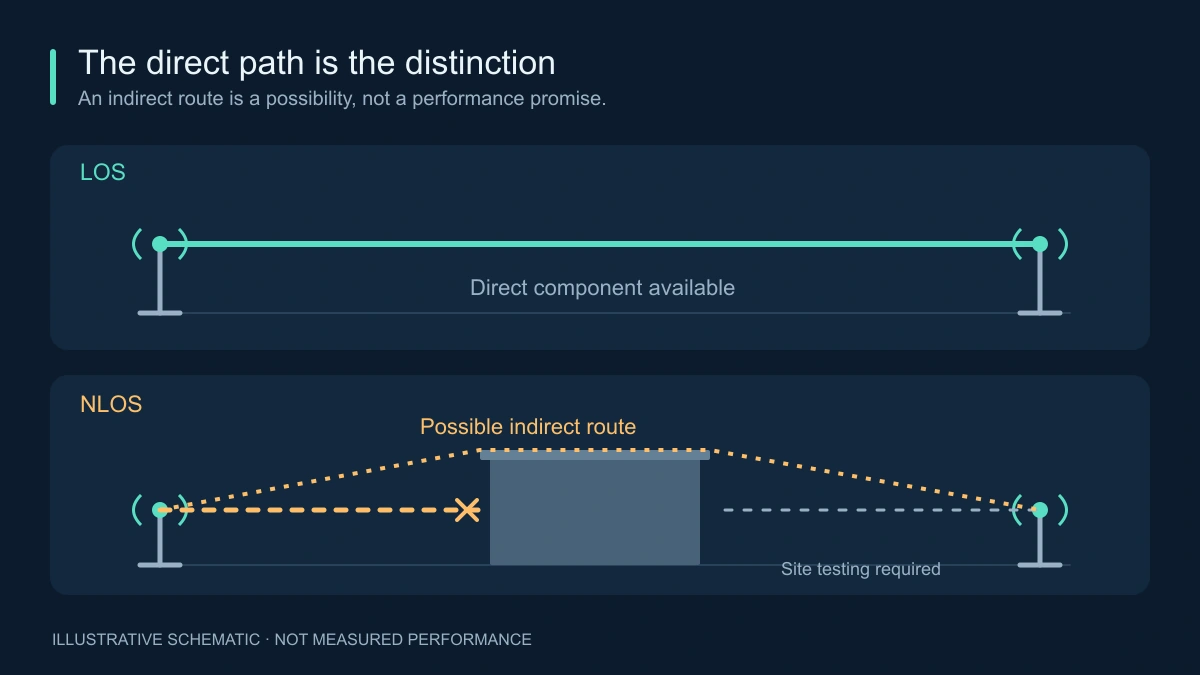
LOS, or line of sight, means the direct path between transmitting and receiving antennas is unobstructed. NLOS, or non-line of sight, means an obstacle blocks that path, so reception relies on signals reaching the receiver through or around the obstruction. These describe propagation conditions, rather than two interchangeable types of radio.
| Comparison | LOS | NLOS | What it means for the project |
|---|---|---|---|
| Available path | A direct path connects the antennas. | Reception depends on transmission through an obstruction or indirect paths. | The obstacle geometry matters alongside the distance. |
| Antenna clearance | The direct line may be clear while nearby objects intrude into the Fresnel zone. | The direct line itself is obstructed. | A visible endpoint and a blocked endpoint require different path assessments. |
| Range and capacity | Usually offers a better starting condition for a long video link. | Additional loss and multipath may reduce capacity or prevent a link. | An LOS distance does not establish an NLOS distance. |
| Stability | A direct component is available, although interference and reflections can still matter. | Reception may depend more heavily on paths that change with the surroundings. | Similar signal readings need not mean similar video performance. |
| Deployment cost | A direct connection may avoid intermediate equipment. | A workable route may require different mounting positions or a relay. | Compare installation and maintenance, not just radio prices. |
These labels describe the path, not a guaranteed video result. The basic terminology follows Sewio's LOS/NLOS definitions.
How Do LOS and NLOS Affect Wireless Video Transmission Range?
Under otherwise comparable conditions, LOS generally offers a better chance of sustaining video over a long distance. An NLOS link must accommodate the losses and multipath of its particular obstruction. There is no reliable fixed percentage for converting a published LOS range into an NLOS range.
The difference begins with how energy reaches the receiver. On an LOS route, a direct signal component is available. Behind an obstruction, the receiver may depend on weaker transmitted, reflected, scattered or diffracted components. A path around a building edge is therefore a different proposition from a path through that building or behind a ridge. Calling all three “NLOS” does not make their achievable distances equivalent.
Capacity is another important distinction. A digital LOS link with adequate margin may sustain the required video rate, while the same equipment on a blocked route may need a more robust, lower-rate setting, if supported, or may not connect at all. A radio that remains connected is not necessarily carrying enough useful data for the intended streams. Compare usable capacity at the proposed distance, rather than treating the maximum radio data rate as a guaranteed video rate.
For an LOS vs NLOS range comparison, a long ground-to-air demonstration and a short ground-level route behind buildings answer different questions. The airborne endpoint may clear obstacles that remain in the ground-level path. The longer result is not evidence that the shorter obstructed route will work. An NLOS claim is useful only when its obstacle conditions and equipment configuration resemble the proposed installation; otherwise it identifies a candidate for testing, rather than an acceptance distance.
Why Do Antenna Height and Fresnel Zone Clearance Matter?
On an LOS route, raising an antenna can improve clearance around an already visible direct path. On an NLOS route, it helps only if the change improves the available propagation path; a small height increase may leave the same building in the way. Height alone is not a substitute for understanding the obstruction.
Visual visibility is narrower than radio clearance. The first Fresnel zone is a region around the direct line between antennas, and objects inside it can weaken reception without blocking that line. A roof just below a visible path can therefore matter to an LOS installation. A building across the direct line presents an additional problem: the direct component is blocked. These situations should not be grouped together simply because both installations have antennas above ground level. Cisco's site preparation guide explains Fresnel clearance and site surveying.
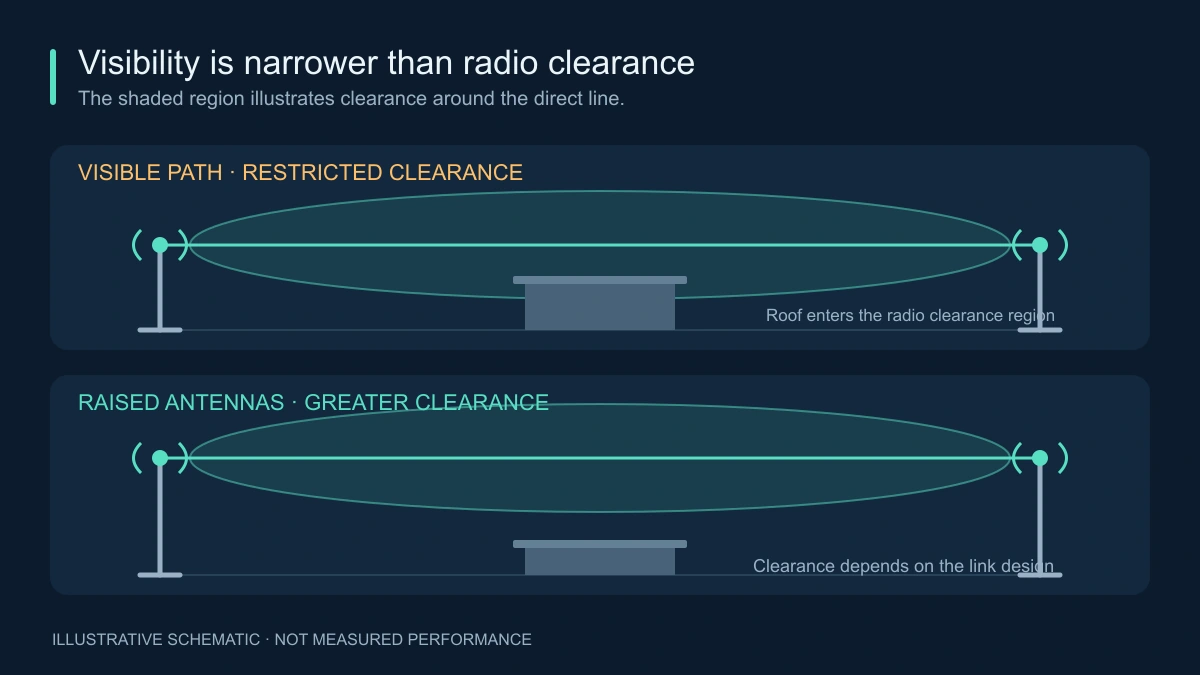
The required clearance depends on frequency, link length and position along the path, so one mounting height cannot suit every route. For a clear fixed link, use those inputs to check roofs, trees and terrain near the line. For a blocked route, establish whether the available mounting positions can clear the main obstruction before refining the surrounding clearance. A neatly calculated Fresnel zone does not remove a building from the direct path.
A ground-to-air LOS result may also depend on an altitude that a ground vehicle cannot reproduce. For a moving platform, compare its lowest or obstructed operating positions with its elevated clear positions. On long paths, include terrain and the relevant Earth-curvature and refraction assumptions in the path profile. The two endpoints alone do not describe the full route.
How Do Obstructions Affect Video Quality and Link Stability?
An LOS link has a direct component that can make reception more predictable. An NLOS link may depend more on indirect components whose strength changes when objects or antennas move. Either can suffer interference, so an obstructed path should not become the explanation for every video fault.
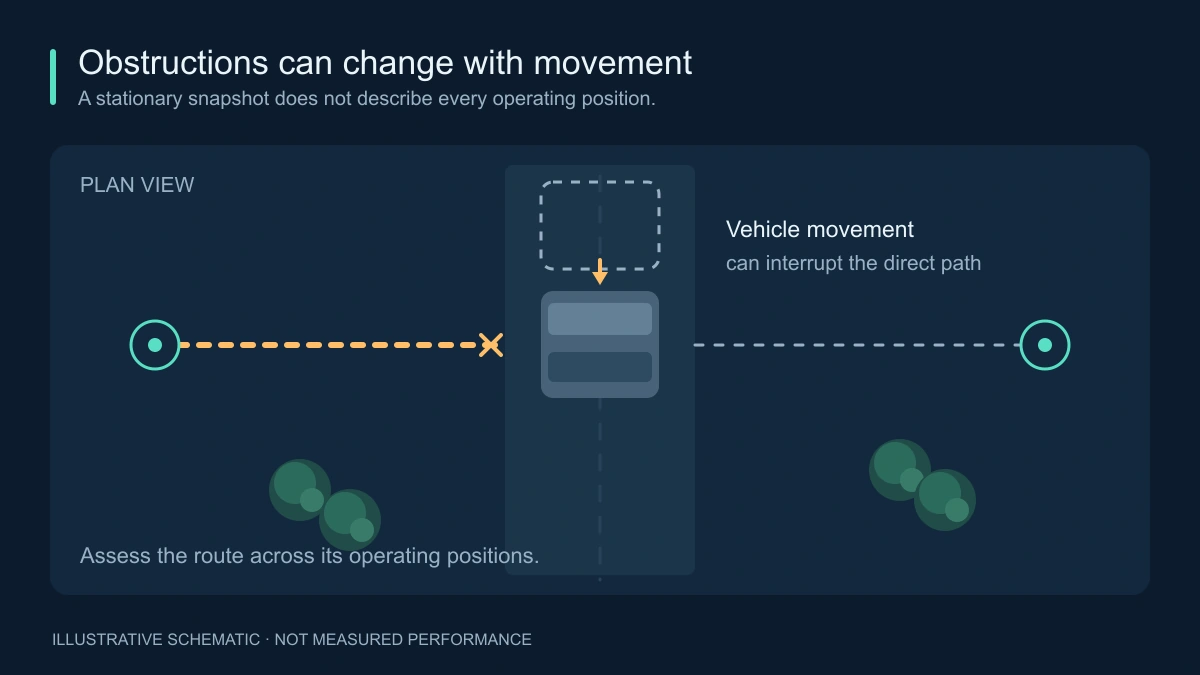
A fixed LOS route with adequate clearance may remain geometrically clear as surrounding activity changes. A route whose direct path is temporarily blocked by a passing vehicle can instead alternate between clear and obstructed conditions. A continuously blocked route may remain connected through reflections, yet change sharply when a vehicle or piece of equipment alters one of those reflected paths. A stationary demonstration does not establish performance throughout that movement.
Trees create a different comparison. An antenna path above the canopy can remain LOS, while a lower path through the foliage experiences conditions that vary with vegetation density and movement. A sparse-branch test does not establish performance through a denser canopy. The appropriate comparison is between the foliage conditions the link will face, rather than between distances alone.
For digital video, reduced usable capacity or packet delivery can appear as freezes, picture breakup or interruptions. Delay depends on the equipment's response: retransmission or buffering may preserve delivery at the cost of latency, while another configuration may discard data. NLOS does not impose one universal extra delay, and LOS does not guarantee a low end-to-end delay. NIST's industrial wireless deployment guide explains why strong RF signals alone do not establish service quality in multipath conditions. Compare the delivered video as well as the radio readings.
Should You Reposition the Antennas or Add a Relay?
Prefer a clearer direct path when a practical mounting change can provide one. It can avoid intermediate equipment and its power and maintenance needs. Where the obstruction cannot be cleared, a relay route may be workable, but it must provide usable paths on both sides of the relay location.
For a fixed LOS installation, better antenna placement and alignment may be enough. For an NLOS route around a building or ridge, an additional location can create two usable hops, at the cost of another installation point. Access and power can make that route more expensive than the radio prices suggest.
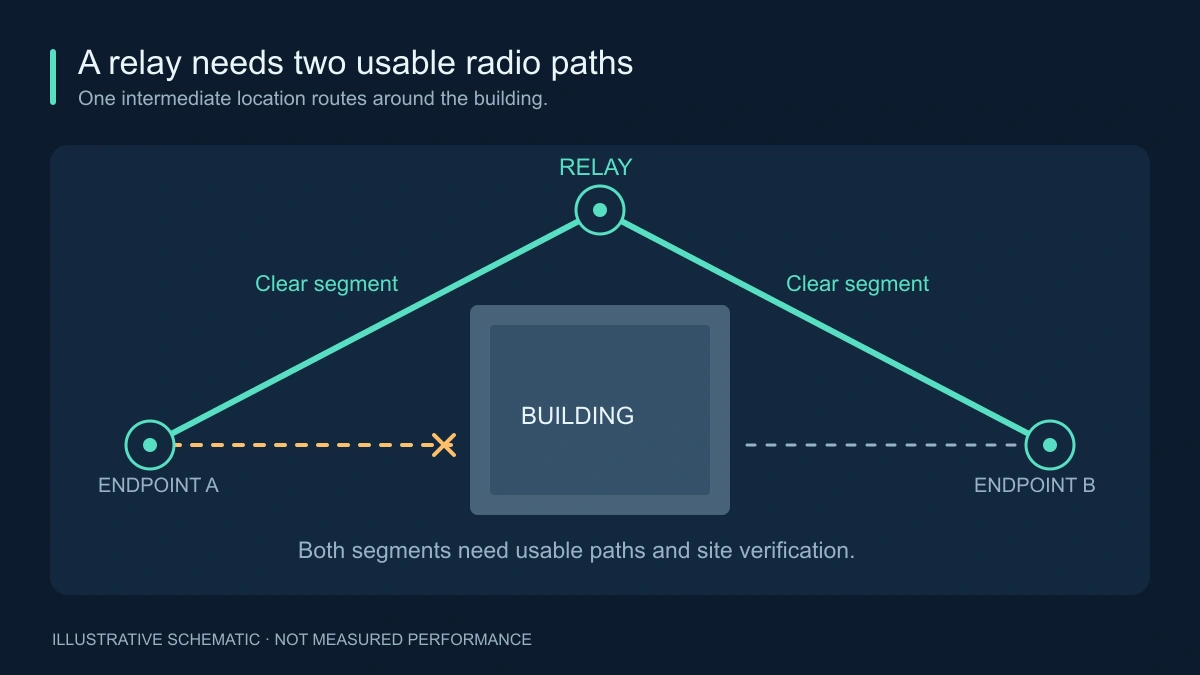
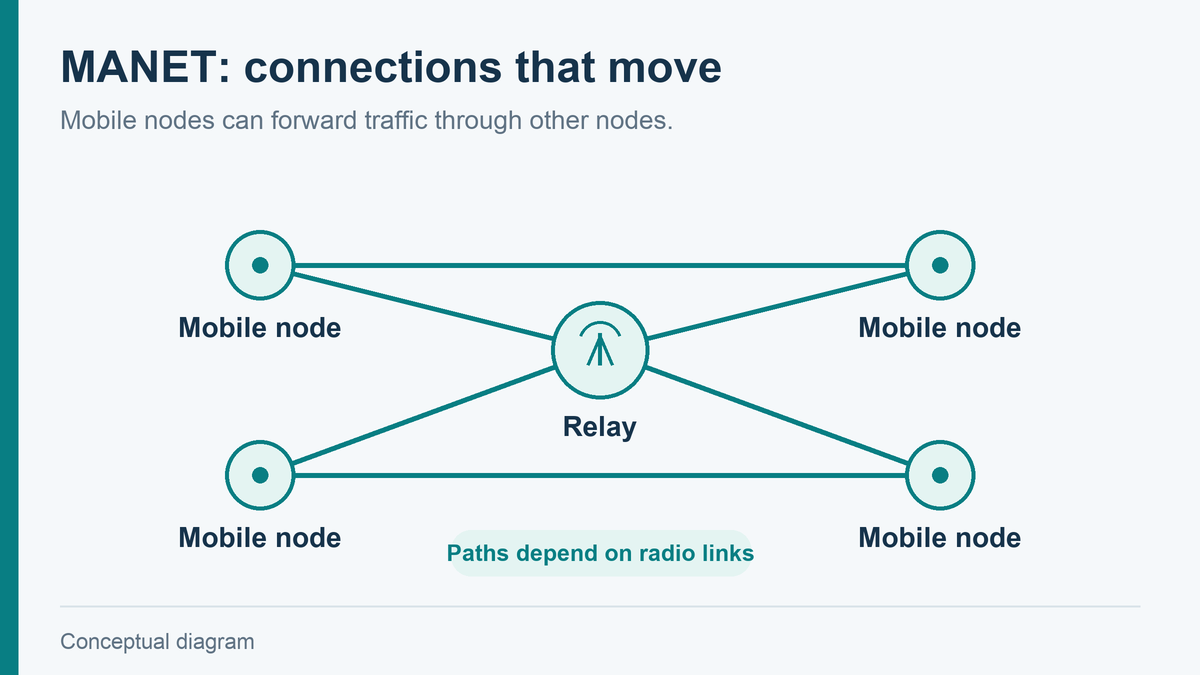
A relay route also differs from a direct link in capacity and delay. Extra hops consume resources; the effect depends on channel use, scheduling and traffic. Do not assign direct-link throughput to the complete route or assume a fixed delay increase per hop. Mesh can offer alternative routes when the equipment and topology support them, but it still needs usable paths between carrying nodes. Neither Mesh nor a COFDM or MIMO label establishes a particular through-wall distance.
What Should You Test Before Accepting a Wireless Video Link?
Use an LOS test as a baseline where practical, then assess the actual NLOS route separately. Accept either against the intended video service, not merely whether the radios connect.
Keep three things in the test record:
- Configuration: radio and firmware version, frequency, bandwidth and power; antenna, cable, alignment and mounting details. These identify which installation produced the result.
- Path and load: endpoint positions or route, obstructions and relevant foliage or movement; camera/encoder settings and simultaneous traffic. These identify where and under what demand the result applies.
- Outcome: delivered throughput, loss, video interruptions, end-to-end latency and recovery. Agree the measurement method, duration and acceptable results before testing.
Include the camera and decoder when measuring video latency. Test the most difficult foreseeable locations within the agreed operating scope, including route recovery if required. A short demonstration does not establish stability for an operating period it did not cover.
Frequently Asked Questions
Is Near-Line-of-Sight the Same as Non-Line-of-Sight?
Not necessarily. “Near-line-of-sight” is often used for a partly obstructed path or restricted clearance, but terminology varies between documents. Ask for a path description or drawing showing what is blocked. A label without the obstacle geometry is too ambiguous to use as a test specification.
Does a Lower Frequency Always Give Better NLOS Performance?
No. Frequency influences propagation, but it does not settle the whole link design. At the same distance, lower frequencies also have a larger first Fresnel zone. Antenna size, available bandwidth, interference and regional operating permissions affect the choice. Compare permitted, supported configurations at the required video load rather than choosing on frequency alone.
Is a One-Way Video Test Enough for a Link That Also Carries Control and Telemetry?
No. A video stream reaching the ground does not demonstrate that commands and telemetry meet their own requirements in both directions. Run the intended traffic together and measure each required direction. Make sure a high video load does not conceal an unacceptable control response or telemetry interruption.
For a discussion with Xingkai, send a route sketch showing the distance, obstacles and available antenna positions, together with the video and simultaneous data requirements. These provide a starting point for discussing a product configuration and what its sample test must demonstrate.